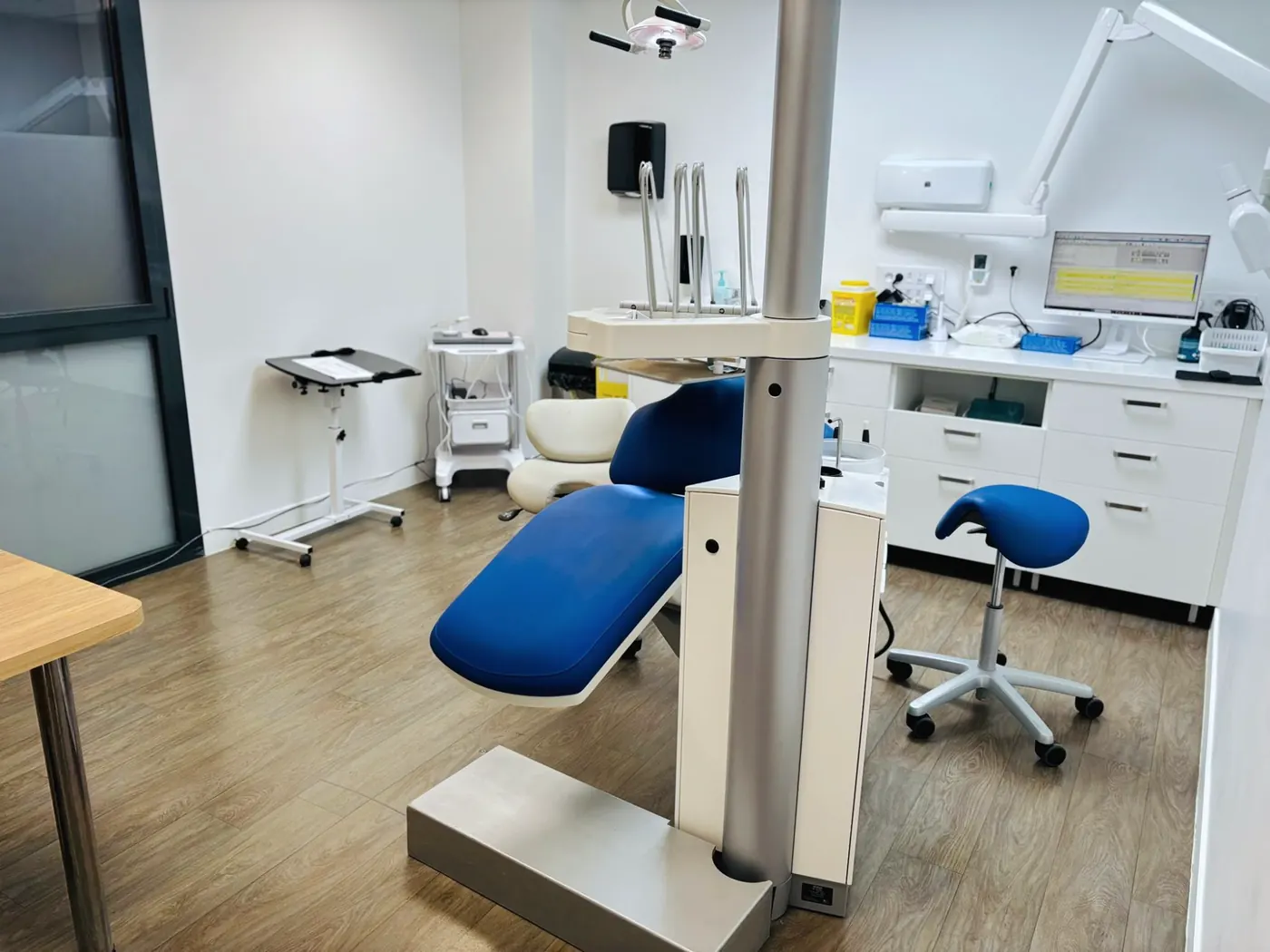
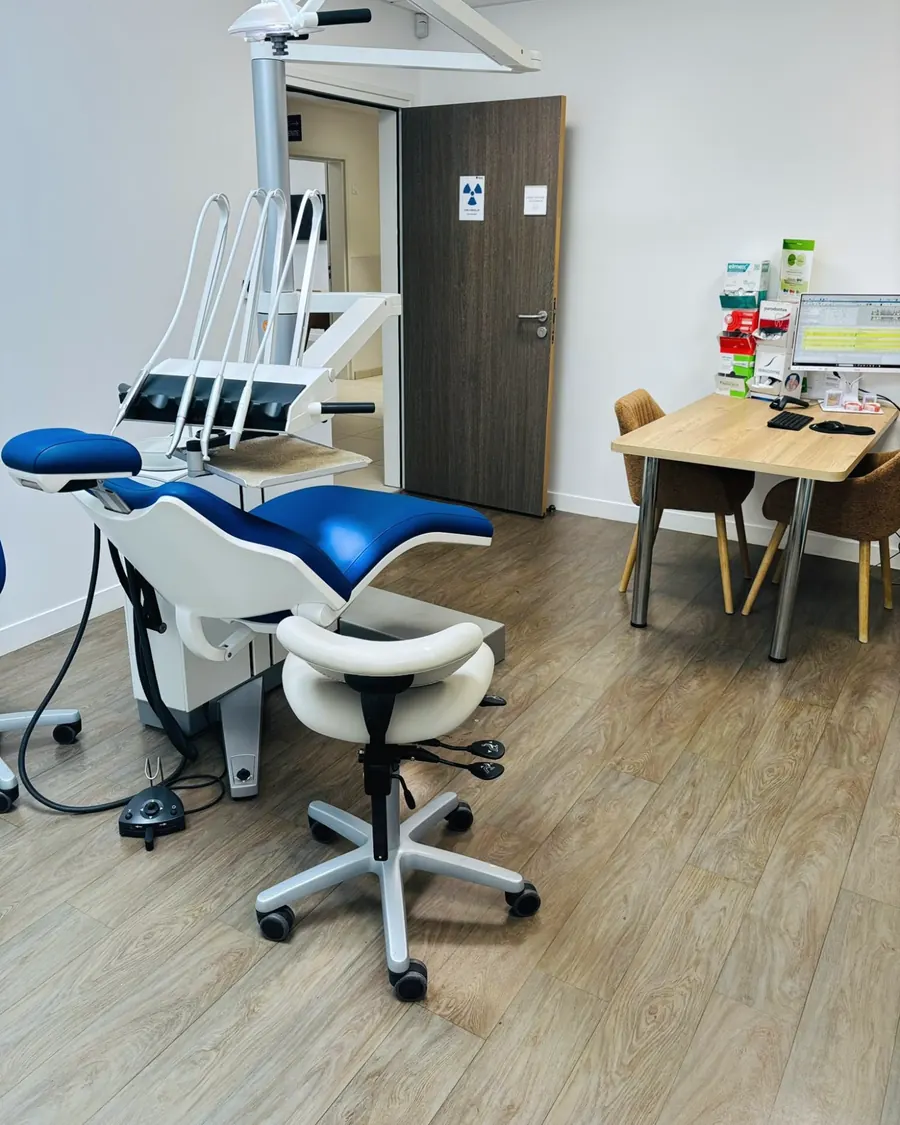
Guides written by our team so you know what to expect and how to look after your teeth.
Oral hygiene
Regular, thorough brushing removes dental plaque, the main cause of tooth decay and gum disease.
1/3Modified Stillman technique: brush at 45° towards the root, resting on both gum and tooth. Small vibrations, then roll the brush up the tooth2/3Front view: the interdental brush slides in below the contact point, above the gum. It should fill the gap without forcing3/3Top view: it goes right through, a few strokes back and forth, morning and evening
Twice a day, two minutes
Brush your teeth morning and evening for two minutes. The evening brush is the most important.
The toothbrush
Choose a soft brush with a small head, manual or electric. Replace it every three months, or sooner if the bristles splay.
Toothpaste
Use a fluoride toothpaste: 1,450 ppm fluoride for adults. For children, the strength depends on age: ask us. After brushing, spit out without rinsing too much.
Between the teeth
Morning and evening, also clean between your teeth with floss or interdental brushes.
Check-ups at the practice
A check-up at least once a year catches problems early and allows a scale and polish if needed.
Tooth decay is caused by bacteria in dental plaque, which turn sugars into acids. These acids attack the enamel, then the dentine.
1/3Decay attacks the enamel: no painTop view: a small spot in a groove, often hard to see2/3It reaches the dentine: sensitivity to cold and sweetThe enamel gives way: a cavity opens at the bottom of the groove3/3It reaches the nerve: pain, root canal treatment neededThe cavity is large and exposes the pulp
What causes it
Poor brushing, snacking and sugary or acidic drinks throughout the day, smoking, a dry mouth.
Where it starts
In the grooves of the teeth, between the teeth and near the gum. In children, fissure sealants protect the molars.
1/3In section: the groove is narrow and deep, the brush cannot reach itOn a permanent molar, deep grooves trap plaque: this is where decay often starts2/3The flowable resin runs to the bottom of the groove, without drillingA flowable resin is applied in the grooves, with no drilling and no anaesthetic3/3The groove is sealed: plaque can no longer settle in itThe grooves are protected. Sealants are mainly recommended when the risk of decay is high; they are checked at every visit
The signs
Early decay does not hurt. Sensitivity to cold or sweet things is a reason to see us. Don’t wait for pain: the earlier it is treated, the simpler the treatment.
Treatment
The decayed part is removed, under local anaesthetic if needed, then the tooth is rebuilt with a tooth-coloured composite filling. If the tooth is badly damaged, a ceramic inlay or onlay strengthens it. If the infection has reached the nerve, root canal treatment is needed (see root canal treatment).
Keeping the tooth alive
When decay is deep but the pulp is still healthy, we try to avoid root canal treatment. After removing the decay, we place Biodentine, a bioactive calcium silicate cement, at the bottom of the cavity. It helps a bridge of dentine to form that protects the pulp: the tooth stays alive. This is only possible if the pulp is not too badly affected; the decision is made after examination and sensitivity tests.
1/4The decay is deep, but the pulp is still healthy2/4The decay is removed without touching the pulp3/4Biodentine, a bioactive cement, is placed at the bottom of the cavity4/4The tooth is restored. The pulp stays alive and protects itself with a dentine bridge
Endodontics treats the inside of the tooth: the pulp, often called the nerve, and the root canals. The aim is to save your tooth, even when the pulp is affected.
When is it needed?
When the pulp is irreversibly inflamed (spontaneous pain, pain that wakes you at night, lasting sensitivity to heat), when it is necrotic, in case of an abscess, or after a blow to the tooth.
Root canal treatment
Under local anaesthetic, the pulp is removed completely. The canals are cleaned, disinfected and shaped, then sealed. An X-ray checks the result. Treatment takes one or two appointments depending on the case.
1/4Decay has reached the pulp: it has become necrotic and the infection spreads to the root tipsTop view: decay has opened the pulp chamber2/4Under anaesthetic, the pulp is removed completely, then the canals are cleaned and shapedThe tooth is opened: a lower first molar has two mesial canals and one distal3/4The canals are sealed; an X-ray checks the resultEach canal is filled4/4The tooth is then restored: filling, onlay or crown depending on how much of it is leftThe opening is closed: the tooth is restored
After treatment
Some discomfort when chewing for a few days is normal. A root-treated tooth is more fragile: it must then be restored with a filling, an onlay or a crown, depending on how much is left.
Retreatment
If a root-treated tooth becomes infected again, the treatment can often be redone: this is called endodontic retreatment.
A living tooth is always better
Whenever possible, root canal treatment is avoided: with deep decay and a pulp that is still healthy, Biodentine can keep the tooth alive (see the guide on tooth decay).
It covers and protects a badly damaged or root-treated tooth. It can also be fitted on an implant.
1/4The tooth is badly damaged or weakenedTop view: large decay2/4It is prepared to receive the crownThe tooth is evenly reduced all around3/4A custom-made ceramic crown is producedThe crown reproduces the cusps and grooves4/4The crown is fitted: the tooth is protectedIt covers the whole tooth
Inlays and onlays
A custom-made ceramic piece bonded to the tooth to rebuild the missing part of a damaged tooth. Only the affected area is removed, so it preserves more of the tooth than a crown.
1/4Part of the tooth is damagedTop view: one cusp is affected2/4Only the affected part is removed: the rest of the tooth is preservedOnly the damaged part is removed3/4A custom-made ceramic piece is producedThe piece is made to the exact shape of the preparation4/4It is bonded and rebuilds the toothIt is bonded: the tooth gets its shape back
1/4In section: the cusps and the central grooveA lower first molar seen from above: five cusps and their grooves2/4The inlay sits inside the tooth, between the cuspsInlay: the piece replaces the inside of the tooth without covering the cusps3/4The onlay also replaces the damaged cuspOnlay: it also covers one or more weakened cusps4/4The crown covers the whole visible part of the toothCrown: the whole tooth is covered, when it is too damaged for a partial restoration
The bridge
It replaces one or two missing teeth by resting on the neighbouring teeth, which must be prepared. It is fixed.
1/4A tooth is missing2/4The two neighbouring teeth are prepared3/4The ceramic bridge is made in one piece4/4It is fixed on the neighbouring teeth and replaces the missing tooth
Removable dentures
Partial or complete, it replaces several teeth and is taken out for cleaning. It can be stabilised with implants.
1/4Top view of the upper jaw: several teeth are missing2/4The denture is custom-made: a plate resting on the palate, with teeth and clasps3/4Once in place, it rests on the palate and gums, and the clasps hold it on the neighbouring teeth4/4It is taken out to be cleaned every day
An implant is an artificial titanium root placed in the bone to replace a missing tooth. It then holds a crown.
1/3A tooth is missing2/3The titanium implant is screwed into the bone, then heals3/3The abutment and crown are fixed on the implant
Advantages
It does not affect the neighbouring teeth, it is fixed, it feels close to a natural tooth, and it limits bone loss after an extraction.
How it works
An assessment with X-rays checks that there is enough bone. The implant is placed under local anaesthetic. It then bonds with the bone over a few weeks to a few months, before the final crown is fitted.
Our implants
We use IDI implants, designed and made in France since 1987, in Montreuil. Each implant is traceable from manufacture to placement.
Good to know
Implants are not placed before growth is complete. Smoking and some medical conditions can affect healing: mention them at your assessment.
Healthy gums are pink and firm and do not bleed when you brush.
1/3Healthy gum: pink and firm2/3Gingivitis: tartar irritates the gum, which bleeds3/3Periodontitis: the bone holding the tooth recedes
Warning signs
Bleeding, swollen or red gums, persistent bad breath, loose teeth or receding gums: see us without delay.
The cause
Plaque and tartar build up under the gum and inflame it: this is gingivitis. Without treatment, the inflammation can reach the bone holding the teeth: this is periodontitis. Smoking and diabetes increase the risk.
1/3Healthy gum: firm and scalloped, the papillae fill the space between the teeth2/3Gingivitis: the gum edge is swollen and bleeds. It is reversible with proper cleaning; left untreated, it can progress to periodontitis, with irreversible bone loss3/3Recession: the gum pulls back and exposes the root, so the tooth looks longer
Treatment
Deep cleaning (scaling and root planing), learning the right brushing technique with interdental brushes, then regular follow-up. In some cases, gum surgery is needed.
Pain, broken tooth, abscess, a fall: call the practice, we answer 24/7.
1/3Hold the tooth by the crown, without touching the root2/3Keep it in milk, or failing that in saliva3/3See a dentist as soon as possible, ideally within the hour
Sundays and public holidays
Call 15 (French emergency medical line), who will direct you to the on-call dentist.
Call 15 immediately
In case of major facial swelling, fever, difficulty swallowing or breathing, or a violent blow.
Knocked-out adult tooth
Hold it by the crown without touching the root, rinse it briefly if it is dirty, keep it in milk or in your saliva, and see a dentist within the hour.
SCM des Templiers, French shared-practice company (société civile de moyens) SIREN 885 400 275 Registered office: Maison médicale du centre bourg, 36 rue de Melun, 77176 Savigny-le-Temple, France Phone: +33 1 83 86 97 81
Publication director
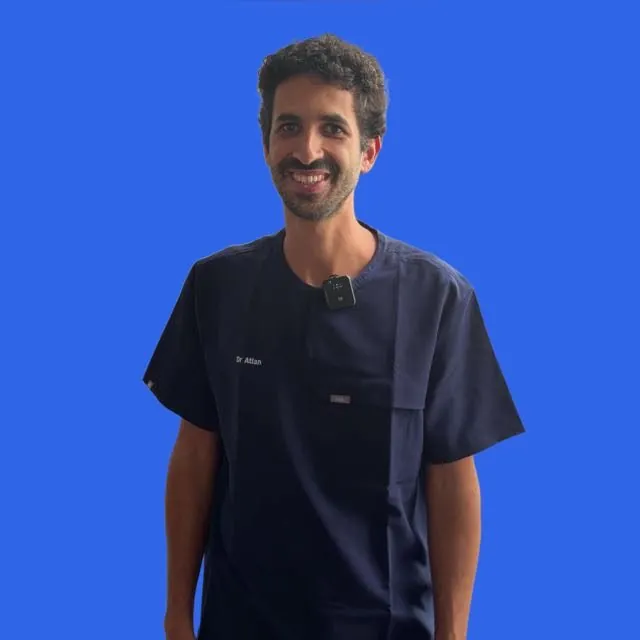
Dr Simon Atlan, manager
Practitioners
Dr Simon Atlan, dental surgeon, RPPS 10101231107
Dr Nils Godkine, dental surgeon, RPPS 10101751724
Dr Ruben Dray, dental surgeon, RPPS 10110361911
The dentists are registered with the French National Order of Dental Surgeons and subject to the French Public Health Code (articles R.4127-201 et seq.).
Hosting provider
GitHub, Inc., 88 Colin P. Kelly Jr. Street, San Francisco, CA 94107, United States
Personal data and cookies
This website sets no cookies and collects no personal data. The “Find us” section shows a map provided by Google Maps, which may set its own cookies.
To measure traffic, the site uses GoatCounter, a cookie-free analytics tool that collects no personal data and cannot identify visitors. The site assistant runs entirely in your browser: your questions are neither stored nor sent.
Online booking takes place on Doctolib, which applies its own privacy policy.
Content
The information on this site is general and does not replace a consultation. In an emergency, call the practice or 15.